
Quick Summary
Expanding floss starts thin to slide into tight gaps, then opens into a textured knit that catches plaque and debris. Whether it cleans better than smooth floss depends on your gap sizes and technique, so judge fit and gum comfort for yourself.
- Expanding floss is a knitted strand that thickens as you use it between teeth.
- Choose GOLD for regular gaps and PLATINUM for tight contacts.
- Use about 18 inches (roughly 45 cm) of floss per clean, with a fresh section for each gap.
- A plaque-removal claim should name the comparison, the measurement and the study conditions.
- Buy the smallest format first to test fit before committing to a bulk pack.
Table of Contents
- Does Expanding Floss Really Clean Better?
- How Expanding Floss Works Between Your Teeth
- Expanding Floss vs. Traditional Dental Floss
- Floss for Tight Contacts: Gold vs. Platinum Fit
- How to Use Expanding Floss Step by Step
- Plaque Removal Claims and What the Evidence Covers
- Choosing the Right WISE FLOSS Size and Pack for Your Routine
- Trying WISE FLOSS EVERYDAY for Your Next Clean
- Frequently Asked Questions
Does Expanding Floss Really Clean Better?
Last Updated: November 1, 2026
Expanding floss is a knitted dental floss that thickens as you use it, and Ecomoxo's WISE FLOSS line is built around that design. The question most people ask is simple: does an expanding floss actually remove more plaque than the smooth floss you already use? The honest answer depends on how you use it, the size of the gaps between your teeth, and what you expect a floss to do. This guide walks through how expanding floss works, where it fits compared with traditional floss, and how to choose a WISE FLOSS option for your routine.
How Expanding Floss Works Between Your Teeth
Expanding floss starts thin enough to slide into a tight contact, then increases in volume as it moves and catches debris. Ecomoxo describes its WISE FLOSS construction as a patented knitted structure with a multi-loop, tiny-knot design. That structure is what gives it its expanding action during flossing.
The practical effect is a fuller, textured surface rather than a smooth strand. The knitted construction is designed to grip and hold plaque and food debris.
Thin insertion and expansion during use
The first step is getting the floss into the gap. A thin starting profile matters most where teeth sit close together. Once the floss is between the teeth, moving it up and down along the tooth surface lets the knit open out. This is the expansion you feel while cleaning, and it is the core of the product's claim.
Knitted structure and texture
The knitted structure also affects how the floss handles. Ecomoxo notes that WISE FLOSS is coated with mint, plant-based wax and xylitol for a smooth glide. The mint, plant-based wax and xylitol coating gives the floss a smooth glide, while the knit texture provides grip on the tooth surface.
Expanding Floss vs. Traditional Dental Floss
Traditional floss is usually a smooth, waxed or unwaxed strand. It is inexpensive, widely available and effective when used correctly. Expanding floss trades some of that simplicity for a textured, expanding design.
| Feature | Expanding floss (WISE FLOSS) | Traditional smooth floss |
|---|---|---|
| Surface | Knitted, textured | Smooth or lightly waxed |
| Behaviour in gaps | Thin start, expands during use | Stays the same width |
| Tight contacts | GOLD and PLATINUM options | Depends on the brand and waxing |
| Price per use | Higher | Lower |
| Best for | Users wanting a textured clean | Users wanting a low-cost basic option |
The core difference is how the floss is constructed. If you want a textured strand that expands between teeth, expanding floss is the category to test.
Floss for Tight Contacts: Gold vs. Platinum Fit
Tight contacts are the spaces between teeth that barely let floss through. Ecomoxo offers two fits in its WISE FLOSS line, and choosing the right one depends on how closely your teeth sit together.
- GOLD (regular contacts): Soft, fuller and textured for regular or wider spaces. Ecomoxo says it expands during use to help remove plaque and food debris.
- PLATINUM (tight contacts): Slimmer and easier-gliding for closely spaced teeth. It moves through tight contacts before it expands to capture debris.
If floss shreds or gets stuck when you try to pass it between two teeth, PLATINUM is the option to try first. If your gaps are wider, GOLD gives more fullness for the job.
How to Use Expanding Floss Step by Step
Using expanding floss correctly makes the difference between a thorough clean and a disappointing one. Follow these steps.
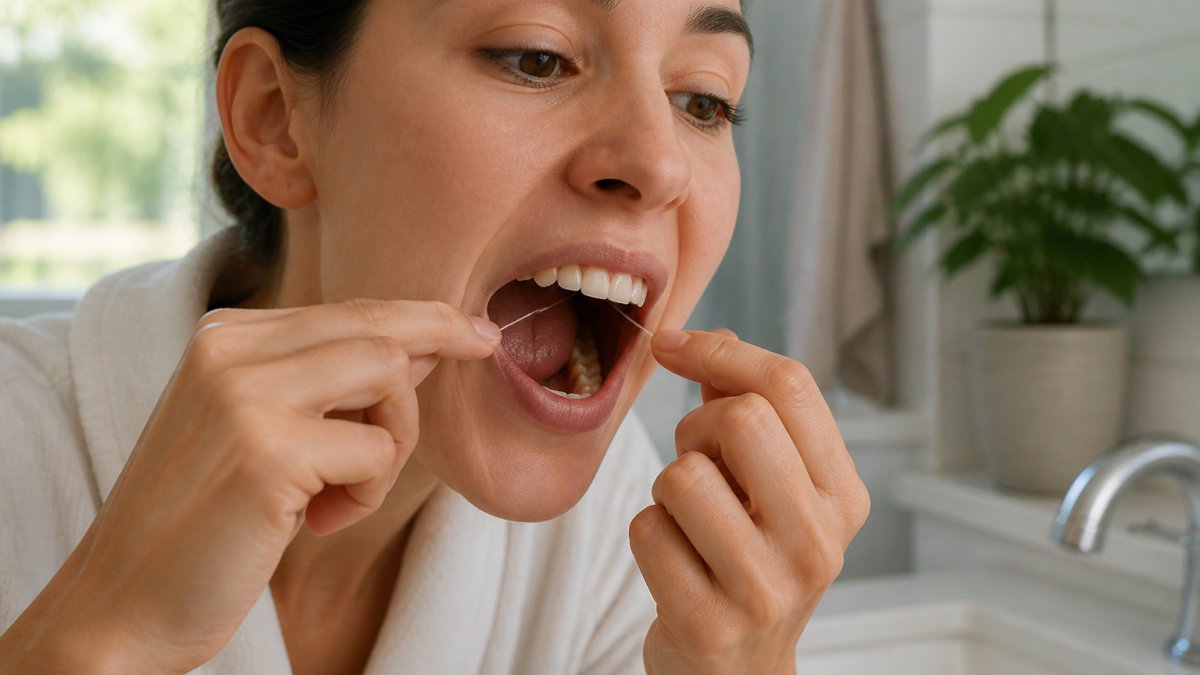
- Cut about 18 inches (roughly 45 cm). A longer length gives you fresh floss for each gap.
- Wrap the ends around your middle fingers. Hold a short section taut between your thumbs and index fingers.
- Guide the floss gently between two teeth. Use a back-and-forth motion.
- Curve the floss into a C-shape against one tooth. Slide it up and down along the tooth surface and under the gumline.
- Repeat on the adjacent tooth. Then move to the next gap with a fresh section of floss.
- Let the floss expand. Give the knit a few gentle passes so it opens and captures debris.
Ease the floss through instead, and switch to PLATINUM if it resists.
Plaque Removal Claims and What the Evidence Covers
Plaque-removal claims are worth separating from what they can actually show. Interdental cleaning, cleaning between the teeth, removes plaque and food debris that a toothbrush does not reach. That principle applies to any floss, expanding or smooth. The more specific question is whether an expanding, textured strand removes more plaque than a standard smooth strand, and how you would know.
What a plaque-removal claim should tell you
A meaningful claim about plaque removal usually needs three details: the comparison (expanding floss versus what, unwaxed floss, waxed floss, interdental brushes?), the measurement (plaque score, bleeding score, or debris removal), and the conditions (how long participants flossed, whether they were supervised, and whether the study was independent). Without those details, a phrase like "removes more plaque" is a marketing statement rather than a finding you can apply to your own mouth.
Published flossing research often compares different interdental cleaning methods, and the evidence for any single product's performance should be judged on its own data.
How to judge the claim for yourself
You can assess three things without a study. First, fit: does the floss pass through your contacts without shredding or snapping? A floss you avoid using removes no plaque at all. Second, coverage: does the strand feel like it is contacting the tooth surface along the side, not just sliding through the gap? Third, gum response: do your gums feel clean and not irritated after a week of consistent use? If the answer to all three is yes, the product is doing its job for you regardless of the label.
Where expanding floss fits with other interdental tools
Expanding floss is one option among several. Interdental brushes and floss each suit different gaps, and many people use whichever tool fits each space. Many practitioners recommend using whichever tool fits each gap rather than one tool for the whole mouth. If you have crowns, bridges, or implants, ask your dentist which interdental tool suits each site.
Speak with your dentist if you have gum concerns, and treat any product claim, including the ones in this guide, as something to verify against your own experience rather than assume.
Choosing the Right WISE FLOSS Size and Pack for Your Routine
WISE FLOSS is sold in several sizes and formats, and the right choice depends less on the sticker price than on how much floss you actually use and where you use it.
| Format | Length | Price | Approx. cost per metre | Best use case |
|---|---|---|---|---|
| EVERYDAY dispenser | 30 m | 9.99 | ~0.33 | First purchase, home bathroom |
| GO travel pack (10/bag) | 5 m each | 14.99 | ~0.30 | Bag, desk, travel |
| EVERYDAY tube (20 pack) | 30 m each | 99.80 | ~0.17 | Households, regular users |
| GO round dispenser (100/bag) | 5 m each | 99.99 | ~0.20 | Offices, hospitality, shared spaces |
| PRO tubes (20 pack) | 100 m each | 199.80 | ~0.10 | Clinics, professional or high-volume use |
Cost per metre is calculated from the listed price and length; it is a guide, not a quote, and it does not include shipping or tax. The pattern is consistent: the larger the pack, the lower the cost per metre, but the higher the upfront outlay and the more storage you need.
How much floss one clean actually uses
A common recommendation is about 18 inches (roughly 45 cm) of floss per session, using a fresh section for each gap. At that rate, a 30 m dispenser covers roughly 65 sessions, about two months of daily flossing for one person. A 5 m GO pack covers roughly 11 sessions, which is why it suits travel and touch-ups rather than a full routine. A 100 m PRO tube covers roughly 220 sessions. These are estimates based on the 45 cm figure; if you use shorter sections, each pack lasts longer.
Matching format to routine
For most individual users, the 30 m EVERYDAY dispenser is the practical starting point: it is the lowest upfront cost and enough floss to build the habit. The GO packs make sense if you want floss in a bag or at work, where a full dispenser is inconvenient. The 20-pack EVERYDAY tubes suit households or anyone who has settled on the product and wants to stop reordering. The 100-bag GO round dispenser and the 20-pack PRO tubes are aimed at shared or professional settings where floss is used by many people and restocking matters more than per-unit price.
Availability and refills
Before buying a bulk format, check that the refill or replacement dispenser is available in your region and that the format fits where you plan to keep it. A 100 m tube is only good value if you have somewhere to store it and a dispenser that works with it.
For most people the decision comes down to two questions: how often do you floss, and where do you keep the floss? Answer those first, then choose the format that fits, not the one with the lowest price per pack.
Trying WISE FLOSS EVERYDAY for Your Next Clean
If you are curious about expanding floss, the simplest test is one dispenser of WISE FLOSS EVERYDAY. Start with the fit that matches your gaps: GOLD for regular spacing, PLATINUM for tight contacts.
For those unsure about the feel, the WISE FLOSS EVERYDAY 30 m dispenser at 9.99 is the lowest-cost route into the range. You can also try a free sample duo of Mint and Waxed floss before committing.
Expanding floss is not a replacement for a good brushing routine or regular dental checkups. Try it, judge the fit for your own teeth, and keep the option that makes daily flossing easy to stick with.
Frequently Asked Questions
What is expanding dental floss?
Expanding dental floss is a knitted, multi-loop thread that starts slim enough to slide between teeth and then fluffs up as you move it. The expansion widens the surface that contacts plaque and food debris. WISE FLOSS uses patented Knitted Technology for this design, and its GOLD version is built for regular or wider spaces while PLATINUM is slimmer for tight contacts. Choose the fit that matches the gaps you are cleaning.
Does expanding floss work for tight teeth?
Yes, when you choose the right fit. The WISE FLOSS PLATINUM version is slim and easy-gliding, so it moves through closely spaced teeth and then expands to help capture plaque and debris. Thicker textured floss can shred or get stuck at tight contacts, which is why a slimmer starting profile matters. If your floss still catches, ease it through slowly rather than forcing it, and check with your dentist if it bleeds or hurts.
Is expanding floss better than regular floss?
The manufacturer states that WISE FLOSS cleans better than smooth floss because the expanding knit can lift and trap more plaque and food debris. Smooth floss can slide past debris in some gaps, while the knitted structure is designed to grip it. Independent comparative studies for this exact product are not in the research supplied, so treat the advantage as the brand's claim. Consistent daily flossing matters more than the floss type alone.
How do you use expanding dental floss?
Break off about 45 cm, wrap most of it around your middle fingers, and leave a short working section between your thumbs and index fingers. Guide the thin section between two teeth without snapping it down, then curve it into a C shape against one tooth and gently move it up and down. Let the floss expand as you work, and use a clean section for each gap. Rinse and check that the gumline is smooth afterward.
