
Table of Contents
- Best Dental Floss for Tight Teeth: Quick Comparison
- What Makes a Dental Floss Suitable for Tight Teeth
- Expandable Dental Floss: How Knitted Technology Handles Tight Contacts
- How to Floss Tight Teeth Without Hurting Your Gums
- Why Floss Shredding Between Teeth Happens and How to Stop It
- Pricing Breakdown: What You Pay for Tight-Contact Floss
- Conclusion: Choosing the Right Floss for Your Spacing
- Frequently Asked Questions
Last Updated: October 14, 2026
Best Dental Floss for Tight Teeth: Quick Comparison
Finding the best dental floss for tight teeth comes down to one feature: a slim, smooth strand that passes through narrow contacts without shredding. WISE FLOSS EVERYDAY PLATINUM, a dentist-invented floss with patented Knitted Technology™, is our top pick because its slim profile glides through closely spaced teeth, then expands during use to capture plaque and food debris. At Ecomoxo, we built our recommendation around that single design problem.

Standard floss often buckles, frays, or snaps when the gap between two teeth is smaller than the floss itself. That friction is why so many people give up on the back molars entirely.
Below, we break down what separates a floss that works in tight contacts from one that fights you, compare the options in our range on price and format, and walk through the technique that stops tight-contact flossing from hurting your gums.
Here is the short version before the detail:
| Floss Option | Format | Best For | Price |
|---|---|---|---|
| WISE FLOSS EVERYDAY PLATINUM - 30 m | Single dispenser | Daily home use, tight contacts | $9.99 |
| WISE FLOSS GO PLATINUM - 5 m (10/bag) | Travel packs | Handbags, work, dining out | $14.99 |
| WISE FLOSS 6 Month Use (GOLD or PLATINUM) | Reusable metal dispenser + 3 spools | Sustainable starter set | $21.99 |
| WISE FLOSS EVERYDAY Tube Dispenser - 20 pack | 20 x 30 m tubes | Families, clinics, resale | $99.99 |
| WISE FLOSS PRO - 100 m (20 tubes) | 20 x 100 m tubes | Dental practices, high volume | $199.99 |
What Makes a Dental Floss Suitable for Tight Teeth
A floss suited to tight teeth is one that passes through a narrow contact without breaking down, then still cleans the surfaces it touches. Two properties decide that: strand thickness and surface friction. If either is wrong, the floss catches on the contact point, frays, and leaves debris behind.
Thin floss solves the entry problem. Coating solves the friction problem. Strength solves the shredding problem. You need all three working together, and that combination is rarer than the packaging suggests.
American Dental Association guidance on interdental cleaning
Thin Dental Floss for Tight Teeth: Why Slim Profile Matters
Thin dental floss for tight teeth matters because the contact point between two adjacent teeth can be narrower than a standard strand. When floss is too thick, it cannot reach the gumline at all. It sits on top of the contact, you feel resistance, and you either force it or skip the tooth.
Forcing it is the worse outcome. A thick strand driven hard into a tight contact presses directly on the gum tissue and can leave it sore for days.
A slim profile changes the mechanics. The strand enters, slides to the gumline, and lets you wrap and clean. WISE FLOSS EVERYDAY PLATINUM is built for exactly this: a slim, easy-gliding strand for closely spaced teeth.
Waxed, Unwaxed, and PTFE Coatings Compared
Waxed floss carries a thin coating that lowers friction, so it slides through tight contacts with less force. Unwaxed nylon has more grip and a rougher texture, which cleans well in wider gaps but catches and frays in narrow ones. PTFE, a monofilament material, is the smoothest of the three and resists shredding, though it has less texture to grab plaque.
The trade-off is consistent: the smoother the coating, the easier the insertion, and the less mechanical grip the strand has on plaque.
Expandable Dental Floss: How Knitted Technology Handles Tight Contacts
Expandable dental floss works on a simple principle: enter thin, clean thick. The strand is constructed so it stays slim while passing through a contact, then widens once it is between the teeth, where the extra surface area can lift plaque and food debris.
This is the design behind WISE FLOSS. Its patented knitted multi-loop and tiny-knot construction expands during flossing, which is how a single strand can suit both tight contacts and regular spacing. The PLATINUM option is the slim version for closely spaced teeth; the GOLD option is the fuller, textured version for regular or wider gaps.

That dual behavior is the part most floss reviews miss. A smooth monofilament stays the same width the whole time. A knitted strand changes shape at the point where cleaning actually happens.
NHS guidance on caring for teeth and gums
How to Floss Tight Teeth Without Hurting Your Gums
Flossing tight teeth without pain comes down to four habits: use a slim strand, use a fresh section each time, keep the motion controlled, and never snap the floss down onto the gum. Most soreness after flossing is caused by technique, not by the floss itself.
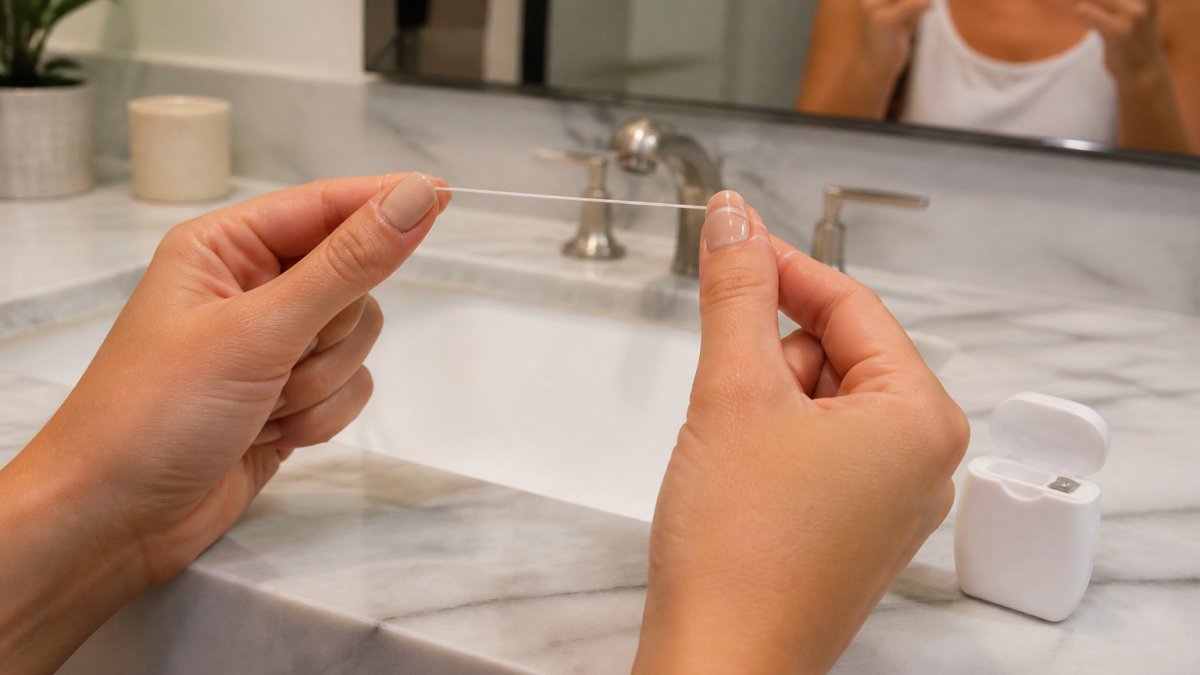
Step-by-Step Technique for Tight Contacts
- Break off roughly 45 cm of floss and wind most of it around one middle finger.
- Wind the rest around the same finger on the other hand, leaving a short working section.
- Guide the strand between two teeth with your thumbs and index fingers.
- Slide it gently through the contact using a light sawing motion, not a snap.
- Curve the floss into a C shape against one tooth and slide it to the gumline.
- Move it up and down the side of the tooth two or three times.
- Repeat against the neighbouring tooth, then unwind a fresh section and move on.
Expect the first few sessions to feel slow. Speed comes after the motion becomes automatic.
Common Mistakes That Irritate Sensitive Gums
The most common mistake is snapping the floss down until it hits gum tissue. That single motion causes most of the bleeding people blame on flossing. A second mistake is reusing the same section of floss across several teeth, which drags debris from one contact into the next and wears the strand out faster.
A third is forcing a thick strand into a contact it cannot pass. If the floss will not go through with light pressure, the strand is wrong for that gap, not your technique.
Why Floss Shredding Between Teeth Happens and How to Stop It
Floss shredding between teeth happens when the strand meets a surface rougher than itself. That surface is usually a filling edge, a crown margin, or a very narrow contact. The floss catches, fibres separate, and you end up with strands left between your teeth.
The fix has two parts. First, switch to a strand built to resist shredding, such as a knitted or monofilament design with a smooth coating. Second, if shredding continues at the same spot every time, have that contact checked. A rough restoration edge will shred every floss you try, and it is a quick fix at the dentist.
Coating matters here too. WISE FLOSS EVERYDAY is coated with mint, plant-based wax, and xylitol, which lowers friction on the way in while the knitted structure does the cleaning once it is through.

Pricing Breakdown: What You Pay for Tight-Contact Floss
Tight-contact floss pricing tracks format more than material. A single dispenser costs the least per unit, travel packs cost more per metre, and professional bulk formats cost the most upfront but the least per metre over time.
| Product | Price | Best For |
|---|---|---|
| WISE FLOSS EVERYDAY PLATINUM - 30 m | $9.99 | Trying a slim floss for the first time |
| WISE FLOSS GO PLATINUM - 5 m (10/bag) | $14.99 | Commuting, travel, eating out |
| WISE FLOSS 6 Month Use | $21.99 | One purchase, six months of daily use |
| WISE FLOSS 6 Month - 12 pack | $84.16 | Families or gifting |
| WISE FLOSS EVERYDAY Tube Dispenser - 20 pack | $99.99 | Clinics and practices |
| WISE FLOSS PRO - 100 m - 20 tubes | $199.99 | High-volume professional use |
For most people with tight contacts, the 6 Month Use set is the sensible starting point. It costs less than three single dispensers and includes a reusable metal dispenser, which cuts the plastic you throw away. If you want to test the feel first, the 30 m single dispenser at $9.99 is the low-risk entry.
Conclusion: Choosing the Right Floss for Your Spacing
The right floss for tight teeth is the one that passes through the contact without force and still cleans once it is through. Thinness gets you in. Coating and strand construction decide whether the clean actually happens.
For tightly spaced teeth, we recommend WISE FLOSS EVERYDAY in PLATINUM. It is dentist-invented, clinically tested, and built on patented Knitted Technology™, so the strand stays slim through the contact and expands between the teeth to capture plaque and food debris. It is also PFAS-free, BPA-free, and phthalate-free, and the GOLD version covers regular spacing if your gaps vary.
Frequently Asked Questions
How do you floss teeth that are super tight?
Use a thin, smooth-gliding floss and take it slowly. Slide the floss gently between the contact rather than snapping it down, then curve it into a C-shape around each tooth and wipe from gumline to crown. A slim monofilament or knitted floss designed for tight contacts moves through closely spaced teeth with less force, which reduces gum trauma and floss breakage. If a gap still resists, try a different angle rather than pushing harder, and see your dentist if the contact feels unusually blocked.
What type of dental floss is best for tight gaps?
Thin, smooth floss works best for tight gaps. Options include PTFE monofilament floss, which glides without fraying, and slim knitted floss that starts thin and expands during use to capture plaque. Waxed nylon floss can also work if it is a thin gauge, but unwaxed nylon tends to shred in narrow contacts. Look for a floss explicitly labelled for tight or close contacts, and check that it passes through the gap without snapping.
Is expandable floss good for tight teeth?
Yes. Expandable dental floss is designed to start slim enough to pass through tight contacts, then widen during flossing to create a larger cleaning surface. That wider surface helps lift and trap plaque and food debris that a smooth, thin strand might slide past. Wise Floss PLATINUM uses patented Knitted Technology to expand between closely spaced teeth, so it combines easy insertion with more thorough plaque removal than a standard flat floss.
What should I do if floss shreds or gets stuck between my teeth?
Stop pulling and gently work the strand out sideways rather than upward, which can cut the gum. Shredding usually means the floss is too thick, unwaxed, or catching on a rough restoration or a very tight contact. Switch to a thin, shred-resistant option such as PTFE or knitted floss, and avoid forcing the strand. If shredding continues at the same spot, ask your dentist to check for a chipped filling or a contact that needs smoothing.
Can a water flosser clean between tightly spaced teeth?
A water flosser can rinse loose debris and massage the gums, but it does not physically wipe the tooth surface the way floss does. For tight contacts, where plaque clings to the sides of adjacent teeth, string floss remains the more thorough option. Many people use a water flosser as a supplement after flossing rather than a replacement. If dexterity or braces make string floss hard, ask your hygienist which combination suits your spacing.
Tight contacts are the hardest place in your mouth to clean, and ordinary smooth floss often slides past the debris rather than lifting it. WISE FLOSS was designed by a dentist to solve that specific problem, with a slim PLATINUM strand for tight contacts, an expanding knitted structure that captures plaque and food debris, and a mint, plant-wax, and xylitol coating for a smooth glide. Get started with WISE FLOSS and make every clean count.